Nutrition
Key #14 — Don’t Forget Nutrition
Fueling right is one of the fastest ways to support consistent training. Dedicated nutrition resources are on the way.
Coming soon
Browse Coach Jay’s articles while you wait →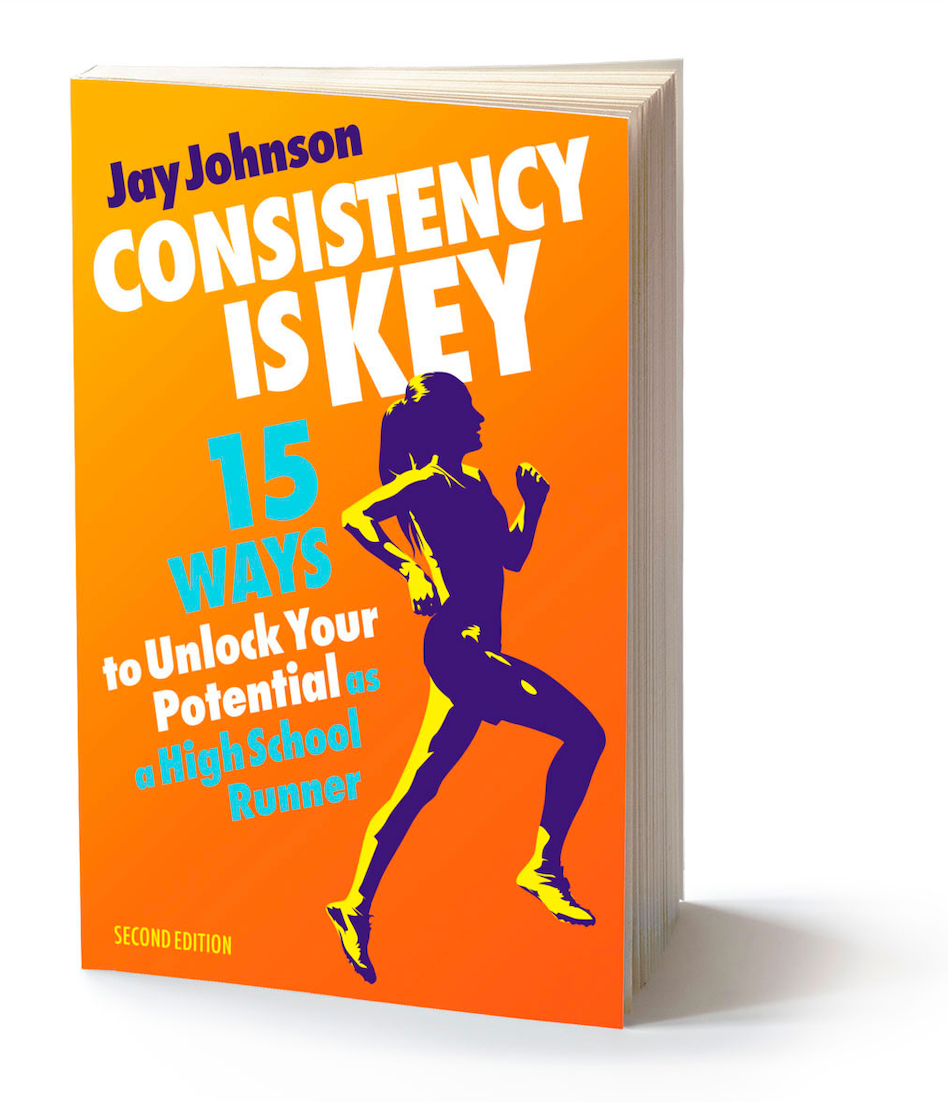
Wonderful book for someone starting out and for the seasoned athlete.
This book was recommended for my three high school sons, and they have all read it and said it gave them practical advice, was motivating, and made them feel confident in their training. And the best part…they’ve seen results!
Thank you, Coach Jay! And your emails are a great resource too. Your name has become a household name at our house.
- Jerry Fedako
As a new HS coach 3 years ago, I found this book and gave it a read. Steering my runners in this direction has been a huge help to them. They feel and run better and continue to improve each season. I cannot wait to introduce them to the 3 bonus chapters (Mental Skills, Health Science, Recruiting) Jay has added to the second edition.
If you want to take your program to the next level, have your runners AND parents read this book.
- Boone Riley
Scan the QR code inside the book?

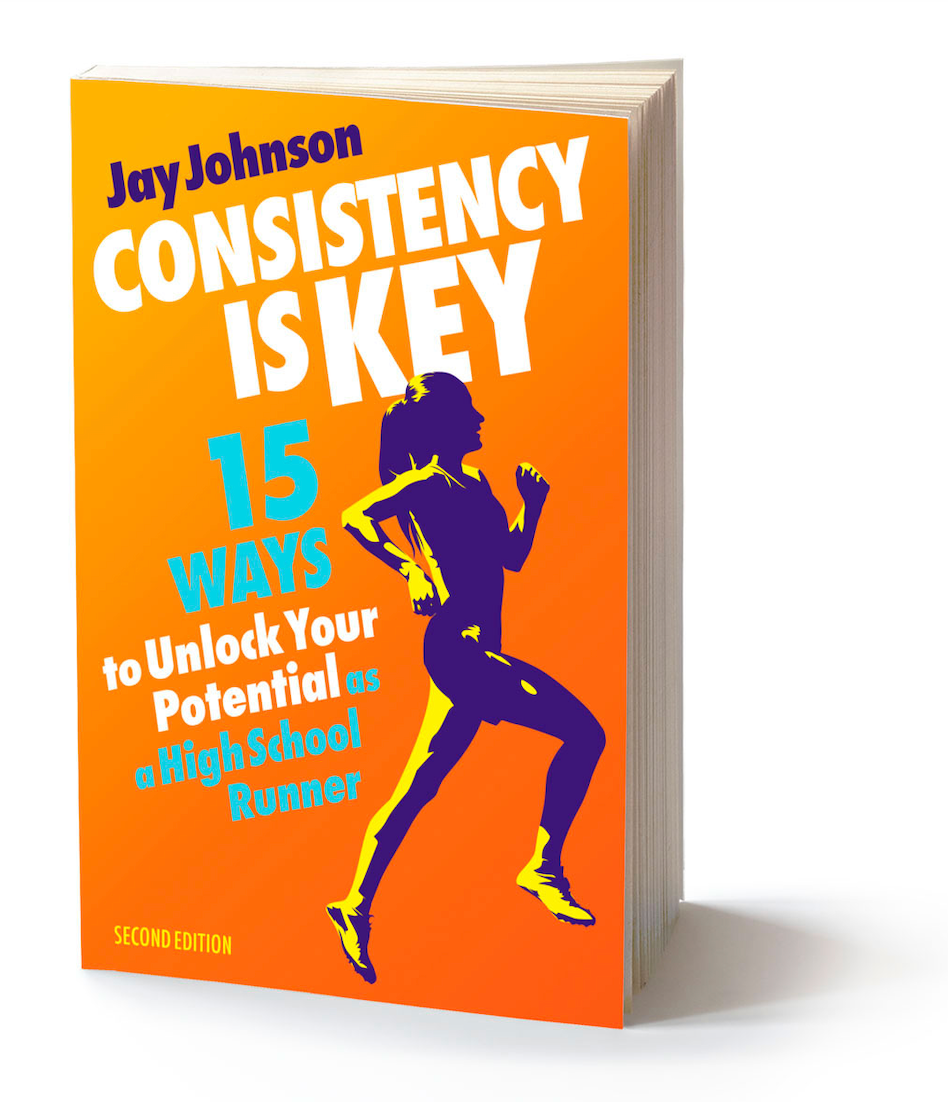
Everything the back cover promises is on this page. Keep improving — free resources for athletes, parents, and coaches, straight from Consistency Is Key: 15 Ways to Unlock Your Potential as a High School Runner, by coach Jay Johnson.
“This is the book I wish I had when I was in high school. It’s a must-read.”
For coaches & programs
Team bundles direct from PFB Publishing save up to 50% versus single copies — the same play top programs run every summer.
See bundle options →For athletes & parents
The free resources promised in the back of the book live right here — built for athletes, parents, and coaches.
Go to free resources →Free resources for athletes, parents & coaches
The book gives you the 15 keys. These free resources help you put the biggest ones into practice.
Key #14 — Don’t Forget Nutrition
Fueling right is one of the fastest ways to support consistent training. Dedicated nutrition resources are on the way.
Coming soon
Browse Coach Jay’s articles while you wait →Bonus chapter — Health Science
Sleep is the highest-leverage recovery tool a high school runner has. Start with the science of sleep for young athletes.
Read: Sleep for High School Runners More sleep articles →Bonus chapter — Recruiting
Want to run in college? The recruiting resource hub is in the works. Until then, race fast enough to get noticed.
Coming soon
Meanwhile: 12 tips to PR on the track →Placeholder — details to come
A resource on what to do in the minutes after you finish a run. Copy and link to be supplied.
TODO: link & copy from Jay
The second edition’s third bonus chapter has a full companion course — plus free articles to get you started.
Six free chapters plus the Niwot team profile. A real look inside the book, delivered free.
Get the free preview →Read before you buy
Read a real sample of the book, then go inside one of the country’s best high school programs. Enter your email and we’ll send the free PDF.
“Your emails are a great resource too. Your name has become a household name at our house.”
For coaches & programs
Coaches across the country assign Consistency Is Key as summer reading, then use its 15 keys as a shared vocabulary all season. Bundles ship direct from PFB Publishing — save up to 50% versus buying single copies.
★★★★★ Verified purchase
“I purchased a set for my athletes and it has greatly helped them understand how incremental steps will help their progression.”
★★★★★ Verified purchase
“I’m a high school cross country coach and I have made this book ‘summer reading’ for my team. I love the way he helps young athletes understand their training without undermining whatever the high school coach might be doing!”
★★★★★ Verified purchase
“Jay reiterates the tried-and-true philosophies good coaches preach to their athletes every day in a concise way that has hit home for my high school kids.”
★★★★★ Verified purchase
“My high school athletes have avoided more injuries and have performed at higher levels than ever. Highly recommend this book to any high school coach or athlete!”
★★★★★ Verified purchase
“The absolute must have book for every High School runner and coach. Jay Johnson is brilliant at taking a complicated subject and making it understandable.”
★★★★★ Verified purchase
“Steering my runners in this direction has been a huge help to them. They feel and run better and continue to improve each season… If you want to take your program to the next level, have your runners AND parents read this book.”
★★★★★ Verified purchase
“Loved this book as a coach but I’m also excited to share it with my athletes. Coach Jay Johnson truly understands where the athlete’s mind is at.”
Inside the book
Four sections. Fifteen fundamentals that won’t change in the coming decades — no matter how much shoes and training tech do.
In this chapter, I separate natural talent from excellence. Two athletes can begin with similar performances and later develop at different rates, but that never removes your opportunity to “transcend a former self.” The work you control—training with energy, staying focused, making smart choices, and working to stay healthy—can help you become an excellent runner even if you are not the most naturally gifted athlete on your team. Your goal is not to win someone else’s genetic lottery. It is to train intelligently enough to race faster than the runner you used to be.
In this chapter, I explain why becoming a better runner requires an attention span for hard work. A long run asks you to stay mentally engaged, maintain good posture, and finish with purpose. The same is true of the strength and mobility work after the run: simple exercises such as planks are not complicated, but they are demanding when you do them consistently. You cannot change the genetics you were born with, but you can grow your capacity for focused effort—on the run, after the run, and over many months. Running is simple. It is not easy.
In this chapter, I show why improvement rarely draws a straight line. Summer training, cross country, winter training, and outdoor track give you repeated opportunities to improve, but some seasons bring dramatic jumps while others bring quieter progress. Travel, school, work, normal development, and minor setbacks all shape that curve. The goal is not to panic when a race or training block falls short of expectations. Control the variables that help you stay healthy, communicate honestly with your coach, and be patient. Mostly injury-free training creates consistency, and consistency gives you many chances to improve across four years.
In this chapter, I explain why there is no magical workout or single system every successful team must follow. Great programs thrive at large and small schools, in rural, suburban, and urban settings. Some make the long run a weekly cornerstone; others use it less often. Some lift three times a week, while others rarely enter a weight room. What they share is a commitment to sound fundamentals and long-term development. Your job is not to copy pieces from every winning team. It is to trust a thoughtful plan that fits your coach, your teammates, and your environment.
In this chapter, I use a car analogy to explain why distance runners need to build their aerobic engines. Every race from 800m through 5,000m gets more of its energy aerobically than anaerobically, and that percentage rises as the race gets longer. I explain what those terms actually mean, why a fitter runner can carry on a conversation at a steady pace, and how the right aerobic work changes what your body can do. You’ll also see why long runs, fartlek runs, progression runs, and threshold runs are useful options—and why building this system consistently throughout the year matters more than chasing one magical workout.
In this chapter, I explain that your aerobic engine can improve faster than your body’s chassis—your bones, muscles, tendons, ligaments, and fascia. That gap is one reason young runners get hurt. The answer is consistent strength and mobility work, including attention to the posterior chain: your low back, glutes, and hamstrings. I show why runners should value this work as much as the run itself and how it can progress from body-weight movements to medicine balls, mini-bands, kettlebells, and eventually heavier loads. You don’t need a fancy weight room; with a modest investment, you can build a stronger chassis almost anywhere.
In this chapter, I make the case for doing strides most days. A stride is a quick run of roughly 70m to 150m—faster than race pace and much faster than normal training pace. Used throughout the year, strides help cross-country runners, milers, and 800m runners stay connected to speed without turning every day into a hard workout. I explain how to progress the number, length, and speed of your strides, why good posture matters, and how late-run strides can give your coach useful feedback about recovery. Consistent strides won’t make you peak too early; they help race pace feel calmer and more familiar when the season matters most.
In this chapter, I make the case that running by feel is one of the most important skills you can develop. It helps you judge the opening pace of a cross country race when terrain, mud, and hills make splits less useful. It also helps you adjust training when soreness, fatigue, or recovery changes what your body can handle that day. This skill takes months—not weeks—to learn. Running by feel does not mean ignoring your coach’s plan. It means paying attention to effort, posture, breathing, and your body so you can race wisely, avoid overtraining, and stay consistent.
In this chapter, I explain why your training needs a clear rhythm of stress and recovery. A race or demanding workout asks a great deal from your body, so the next day should help you absorb that work rather than pile on more fatigue. The common mistake is turning easy days into medium days, then arriving at hard sessions too tired to run well. Easy running is not wasted running; it is what allows the hard work to do its job. Learn to respect both kinds of days, listen to your body, and give each run the effort it actually calls for.
In this chapter, I show why building your aerobic engine is not enough: your legs must also become comfortable at the pace you want to race. You will learn the difference between date pace—what you can race today—and goal pace—what you want to race later in the season. Short repetitions at goal pace, and occasionally a little faster, should appear early enough that the rhythm feels familiar when championship racing arrives. The distances and workouts can vary, but the principle does not: you cannot expect your body to hold a pace in competition that it has never practiced.
In this chapter, I give you a simple test for keeping workouts under control. At the end of almost every session, you should be able to say, “I could have gone farther,” “I could have gone faster,” or both. A workout is not a race, and regularly finishing completely spent makes it harder to recover and train consistently. Time trials are the obvious exception, but most long runs and challenging sessions should leave something in reserve. The goal is to stay on top of your training—not buried under it—so today’s hard work helps you return ready for the next important day.
In this chapter, I show you how to practice switching gears before you need the skill on race day. Most strong performances from the mile up use an even or negative split, which means you need to accelerate when you’re already tired. I give workout examples where the final repetitions go fast, faster, fastest and explain how to rehearse a gear change during the last 100m or 200m of a repeat. You’ll also see a practical 1,600m plan for building speed over the final 500m. The 800m is often different, but the lesson still applies: you can’t expect a great finish if you haven’t practiced changing gears all year.
In this chapter, I call sleep the least exciting—but most essential—ingredient in becoming an excellent high school runner. Sleep helps you absorb training, recover from racing, grow through adolescence, and handle the demands of school. Using a brutally honest “championship sleep” chart, I show how to work backward from your wake-up time and find a realistic bedtime. One bad night won’t ruin a season; the goal is consistency. I also introduce sleep hygiene: a repeatable routine that helps your body settle down, including getting away from your phone before bed. Sleep more, sleep better, and each night can support better training and faster racing.
In this chapter, I explain how to fuel a growing body that is also training hard. You do not need a perfect diet or rigid food rules, but you do need more nutritious whole foods—and more total food—than many non-athletes. Carbohydrates support endurance training, protein supports repair, and a wide range of fruits, vegetables, fats, and other minimally processed foods helps your body handle the work. Under-fueling can leave you exhausted and can contribute to RED-S in both boys and girls. Aim for balance, enjoy treats without guilt, and make “well fueled” part of being consistent.
In this chapter, I help you distinguish normal training soreness from discomfort that may be the start of an injury. Use your pre-run routine and a quick post-run body inventory to notice what is changing in your calves, Achilles tendons, quads, hamstrings, and other common trouble spots. When something feels wrong, tell your coach early and be willing to adjust, cross-train, or take a day off. You do not need an overwhelming list of recovery chores; a few consistent minutes of mobility or soft-tissue work can make a difference. Listening early protects the training you want to do later.
In this chapter, I treat mental preparation as a skill—not something you either have or don’t have. Your goal is to race to your fitness level, which takes practice just like aerobic training does. I explain how to use race-pace workouts to rehearse staying calm and switching gears, then introduce a loose focus plan that breaks the race into manageable segments. You’ll learn about making three competitive moves, “moving by staying still” when a competitor challenges you, and using 10 quick steps to close a gap. These are practical tools you can train over weeks and months so that confidence on race day comes from preparation.
In this chapter, I explain the health science serious runners need to understand beyond sleep, nutrition, and listening to their bodies. Red blood cells carry oxygen, hemoglobin does much of that work, and your body needs iron to make hemoglobin. If fatigue rises while performances fall, a knowledgeable doctor can use bloodwork to check for iron-deficiency anemia and interpret the results. I also explain RED-S—what happens when daily food does not cover growth, life, and training—and why it affects athletes of every gender and ability. These problems can be addressed, but recognizing them early matters.
In this chapter, I outline the first steps for high school runners who want to compete in college. The right school has to fit academically, athletically, socially, and financially, so the process belongs to you and your family. I show you how to write a concise first email to a coach with useful PRs, grades, test scores, and key regional results—without burying the coach in extras. You’ll also learn the difference between walk-ons, recruited walk-ons, full scholarships, and partial scholarships, and why understanding the actual percentage of your total college cost matters.
An inside look at 8 of the country’s best programs, including NXN powerhouses Niwot, Mountain Vista, American Fork, and Naperville North.
In the Niwot profile, I show how one of the country’s strongest high school programs combines ambitious goals with patient progression. You’ll see how Coach Kelly Christensen uses broken tempo runs for younger athletes, gives runners enough recovery to rejoin the pack, and makes strength and mobility part of the weekly rhythm. The profile also covers the team’s use of hurdle mobility, mini-bands, rope stretching, strides, hill sprints, and flying 30s. Just as important, it shows how summer camp, “leveling up,” and inclusive team travel reinforce the culture. The point isn’t to copy Niwot exactly—it’s to see how sound fundamentals can fit a unique team.
From verified Amazon reviews
Ten verified reviews move from right to left. Hover over any card to pause and read. Read them all on Amazon →
★★★★★ “I’m making my whole team read it!”
“I’m a high school cross country coach and I have made this book ‘summer reading’ for my team. I love the way he helps young athletes understand their training without undermining whatever the high school coach might be doing!”
★★★★★ “Highly Recommend”
“My high school athletes have avoided more injuries and have performed at higher levels than ever. Highly recommend this book to any high school coach or athlete!”
★★★★★ “The best High School coaching book!”
“The absolute must have book for every High School runner and coach. Jay Johnson is brilliant at taking a complicated subject and making it understandable.”
★★★★★ “Great read”
“We read most of the book together… His level of understanding, motivation and confidence have noticeably increased and improved. Great addition to his collection.”
★★★★★ “Must Read for Runners, Parents and Coaches!”
“Steering my runners in this direction has been a huge help to them. They feel and run better and continue to improve each season… If you want to take your program to the next level, have your runners AND parents read this book.”
★★★★★ “Great Springboard for Team Discussions”
“Jay reiterates the tried-and-true philosophies good coaches preach to their athletes everyday in a concise way that has hit home for my high school kids.”
★★★★★ “The best book for high school distance runners”
“The book is entertaining, tells great stories, and paints a clear picture of ‘what to do’ to become the best distance runner you can be.”
★★★★★ “Great Read for Coaches and Athletes”
“The more the athletes know and understand, the better their buy in will be. I purchased a set for my athletes and it has greatly helped them understand how incremental steps will help their progression.”
★★★★★ “Great resource for athletes and coaches!”
“Loved this book as a coach but I’m also excited to share it with my athletes. Coach Jay Johnson truly understands where the athlete’s mind is at.”
★★★★★ “Good stuff!”
“Great book every high school runner should read to get on track, pun intended.”
Ratings shown are from Amazon: 4.8/5 across 179 ratings (first edition) and 4.5/5 across 45 ratings (second edition), as of July 2026. Excerpts shortened with “…”, never altered.
When you’re ready
Paperback, second edition — 210 pages with the three bonus chapters and eight team profiles.
Buy one on AmazonBest value for teams
Multi-copy bundles direct from PFB Publishing — save up to 50% versus single copies.
Buy a bundle

Get started today before this once in a lifetime opportunity expires.