
The Field House
Launching in December 2026.
A community for high school cross country and track coaches who care deeply about the sport and want to keep getting better. A place to ask honest questions, share what’s working, and learn from your peers throughout the year.
The first cohort will be open to coaches who attended Boulder Running Clinics or own both the Cross Country and Track Training Systems.
The conversations continue
What Is The Field House?
Think of The Field House as the digital version of the coaches’ socials at Boulder Running Clinics. A place to compare approaches, ask honest questions, and get to know coaches you’ll want to keep talking with throughout the year.
I also hear every week from thoughtful coaches using my training systems. They’re asking good questions, making adjustments, and working to become better coaches. But right now, they don’t have a place to learn from one another.
The Field House brings those two groups together. You don’t have to train the same way. You do have to care about getting better and be willing to contribute.
What coaches value about the clinic socials
“The people attending the clinic are as decorated and insightful as the presenters, and the coaches socials and connections made at the clinic lead to a constant ‘coaching clinic’ with texts and phone calls throughout the year.”
“Unique in that the caliber of presenter was equaled by the attendees. Therefore, not only were presentations phenomenal, but the in-between presentations and socials were also rich in the sharing of ideas, etc.”
“The coach’s socials were another highlight of the weekend. I was blown away by the wealth of knowledge from the other attendees, and there was a spirit of community that I haven’t found anywhere else.”
Your questions about The Field House
Who is it for?
This is just for high school coaches. We won’t be mixing in adult runners, adult running coaches, or triathlon coaches. We’re bringing together people working through the same kinds of challenges with high school athletes.
The first cohort will be open to coaches who’ve attended Boulder Running Clinics or own both the Cross Country and Track Training Systems.
What will I do in The Field House?
Bring a question about training that isn’t clicking. Share an adjustment that helped your team. Ask another coach why they approach something differently. These are the conversations I see at the clinic and have with coaches over email and in live classes. The Field House gives us a place to have them together throughout the year.
We’ll also bring in guest coaches for a month at a time, with webinars exclusively inside The Field House. These are separate from Boulder Running Clinics presentations and won’t be available to watch for free.
Will it fit into my schedule?
You can pop in every few days and use trending posts to catch up on conversations. Bring a question when you have one, or contribute to a discussion when you have something useful to share.
When there’s a 30-minute video I want to learn from in my business community, I don’t sit and watch it. I play it on my phone like a podcast while I walk the dog. If I pause halfway through and come back a day or two later, it picks up where I left off. That makes it easier to fit learning into my day.
Do I need your training systems?
No. If you’ve attended Boulder Running Clinics, you don’t need to own either training system to join.
The community is training-agnostic. You don’t have to follow my approach to learn from the coaches here. I’m interested in seeing how people question, adapt, and improve what they’re doing. We’ll also have separate spaces where coaches using each training system can learn from one another.
How is it different from a Facebook group?
It’s pretty simple: you get what you pay for. I’ve read Facebook threads where well-intentioned coaches give advice that, at a minimum, isn’t going to lead to optimal performance and, at worst, is going to get kids hurt. Being the most active person in a thread doesn’t make you the person with the most useful advice.
We’re starting with coaches who’ve already made a meaningful investment in their coaching education. Some have developed state champions and teams that finish on the podium. Others are working hard to take that next step. I want those coaches learning from one another.
I’ll help keep useful contributions visible and the conversations focused. The point is to understand the experience and thinking behind an answer, then consider how it applies to your athletes.
Will it be easy to use?
We’ll use Circle, a platform I’ve used in business communities for several years. One of the reasons I like checking in most days is how easy it is to read. It’s well laid out, and I can find the conversations I want to follow. I’ll keep our setup focused on what we need.
You can send someone a private message or start a private group chat with a handful of coaches. Conversations will be organized by topic, and search will help you find a discussion you remember.
The Field House won’t be great because of the technology, but the technology won’t get in the way of us having a great experience.
What will Jay’s involvement be?
My role is much like my role at the clinic: bring coaches together and get them talking. I’ll start conversations, participate, and curate the main feed. Sometimes I’ll move a discussion into a more specific space. Other times I’ll bring a post to the top because I think it’s worth everyone’s attention.
This is a place for coaches to learn from one another and build relationships. It isn’t an open-ended personal Q&A with me, including in the training-system spaces.
What is the cost?
There are other coaching communities that cost $15 a month and others that cost $350 a year. Our annual price will fall between those two price points.
A crucial thing to understand now is that there’ll be a founder’s price. If you take the plunge and commit early, you’ll lock in that price for the lifetime of The Field House. A year from now, when the price increases for coaches who join later, you’ll still pay your founder’s price.
I’m committed to this long term, and I plan on raising the price several times in the coming years. Being in early matters.
It’ll be an annual fee, with one important caveat: you’ll be able to make three monthly payments to enroll. More on that in December when we launch The Field House.
The Story Behind The Field House
Here's the backstory on why I'm calling this community The Field House.
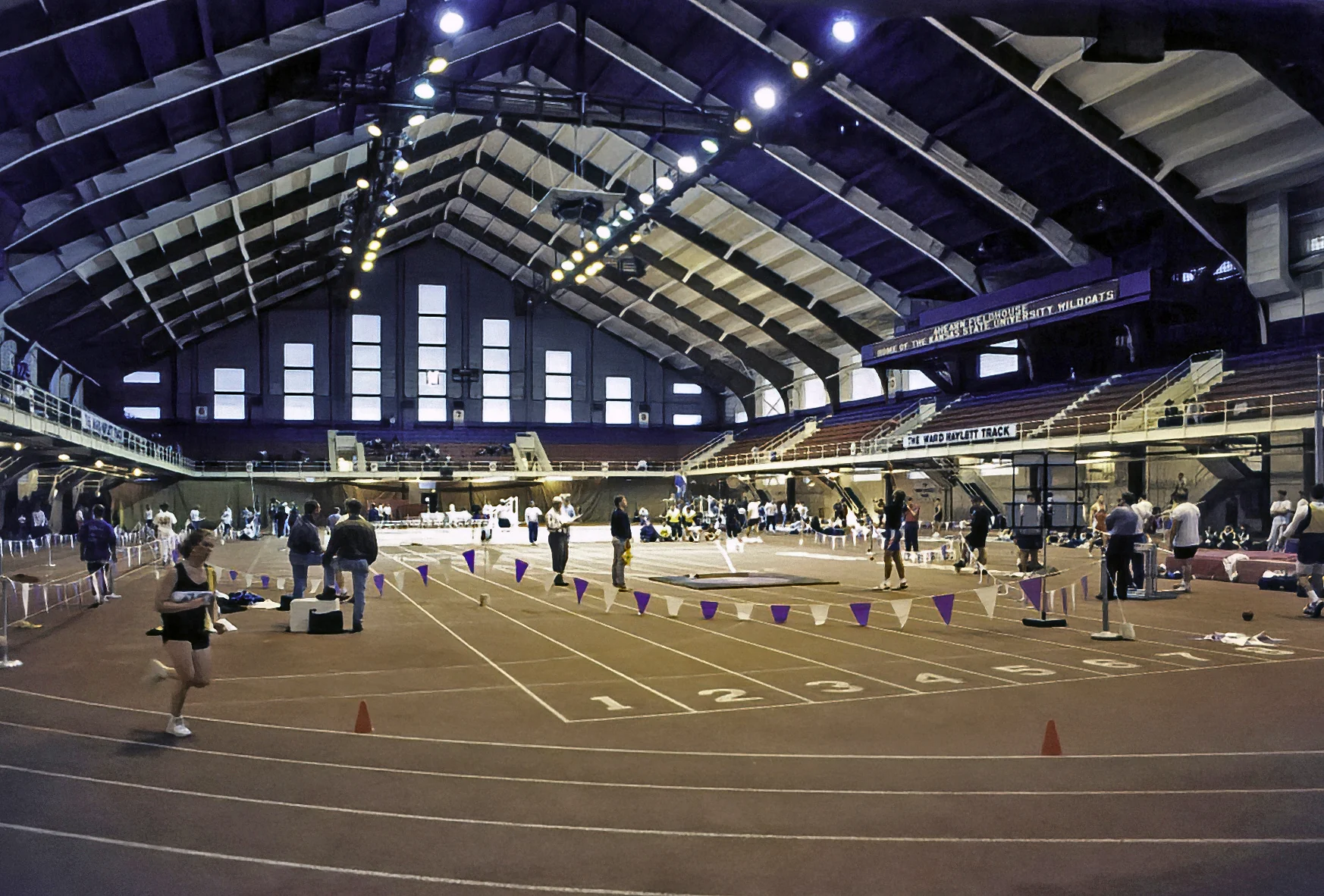
Ahearn Field House, on the campus of Kansas State University, has a special place in both my athletic career and my coaching career. As a freshman, I finished ninth in the 3000m at the 1995 Big 8 Championships. No points, but that was good enough for Coach Jerry Quiller to give me - a walk-on - a ten percent scholarship for the next season.
Then, in my final year of eligibility, I ran the two best races of my career at the 1999 Big 12 Championships: second in the 5000m, fourth in the 3000m, good for thirteen points. I'm still proud of that point total all these years later, though my times wouldn't score in a modern Power 4 meet. My teammate and friend Mike Friedberg passed me in the last 20m of that race to win. Twenty-five-plus years later, he still reminds me...every time I see him...that if I had just been patient and made my move a little later, I could have been the Big 12 champion. 😂
Two years later, in my first job as a junior college coach at Pratt Community College (Pratt, KS), my athletes would compete on the same track. We'd sit in the stands above the first curve, and I can picture it like it was yesterday: one of my best athletes sound asleep in the bleachers up to the time he needed to start warming up. I was certain he'd bomb, but each time he ran great. It was a great lesson early in my coaching: every athlete is different.
Those stories explain why Ahearn Field House is special to me.
But the main reason I'm borrowing its name for this community is what I learned from Mike Smith, the distance coach at Kansas State, in that same field house.
When I was coaching at the University of Colorado, I had three roles. I was the assistant cross country coach, the recruiting coordinator, and the middle distance coach. The best middle distance athletes in the Big 12 at the time, on both the women's and men's sides, were at Kansas State University. His group included Christian Smith, who set the collegiate record in the 1,000 meters and went on to make the 2008 US Olympic Team at 800m (this is a must-watch video of the 2008 Olympic Trials if you haven't seen it).
When we were competing at the same meets, I'd see his athletes warming up before their races, and they were doing some crazy things, such as throwing med balls as part of their warm-up. I later learned it was a way to stimulate the nervous system and get them ready to compete, but it looked bizarre. I was curious and had to know what his rationale was. I asked him a pretty simple question: Could I come out to Manhattan, Kansas, and learn from him? He said yes.
After hours of conversations I had this idea to film all the things he was doing and create a resource that you may remember you've been around the sport for a couple of decades: a set of DVDs called Building a Better Runner: Building from the Ground Up. We did one volume, and then a couple of years later, I went back out and we shot the second volume. The reason this is important today is that the Myrtl routine, the SAM routines, and the red and orange post-run routines you're hopefully using now are all rooted in what I learned in Ahearn Field House.
And that brings us to where we are today.
I was learning from an elite coach, learning things I was curious about, but also things that would've taken me years to get to on my own. The community I'm going to nurture is one where that's going to happen - you learning from each other, figuring out how you can take your program to the next level.
But that's not all.
When I was coaching at the University of Colorado, Mike was my closest friend in the coaching world. And that's also what we're going to foster in The Field House: creating friendships you don't currently have but will build as you stay engaged in the community.
I'm limiting the first cohort to two groups of people. The first group is people who've attended the Boulder Running Clinics. Every year, we have between 200 and 225 people attending the clinic. Most of these coaches have flown to Colorado to be a part of the event and grow as coaches. The coaches who drive in are still sacrificing a weekend in the offseason when they could be relaxing. That's a level of commitment to their coaching education that I believe is unparalleled in high school distance running, and it's a big reason I think the energy at the coaches' socials is so special.
The second group is coaches who have both the XC Training System and Track Training System. They've spent nearly a thousand dollars on their own coaching education and have made a commitment to their athletes to become the best coach they can be.
The pushback I'm going to get is that this is elitist. But what I want is a community where coaches have “skin in the game” through the time and money they've already invested in their coaching education. Having been in more than one online community for entrepreneurs, I can tell you that when the price is a little bit higher, everybody takes it a little more seriously and spends more time engaging with each other. That's the type of community I want to foster and also be a part of as a member.
You’ll be able to lock in the founding-member price when we open.
Thanks for reading. If you have questions about The Field House, click here to read the Q&A or contact us at info@coachjayjohnson.com.
You made it this far