
800m Training: Pre-race Day
Continue reading...
📌 KEY TAKEAWAYS
- Three goals: Neuromuscularly ready, mentally ready, no carry-over fatigue
- Start with Jeff Boelé's dynamic warm-up (13 min, all three planes of motion)
- 5-10 min easy run → skipping/sprint drills → spike up
- Key workout: 3 x 150m In-n-Outs (50m build, 50m fast at 92-96%, 50m run out)
- Then 2 x 200m at race pace: First from standing start, second with 20m run-in
- Cues: "Up tall" and "fast and relaxed" — never give more tha...

How To Train For Cross Country: A Comprehensive Cross Country Training Plan
Continue reading...
📌 KEY TAKEAWAYS
- The Car Analogy: Build the aerobic engine, strengthen the chassis, rev the engine with strides
- 5000m cross country = 95% aerobic metabolism — build that engine year-round
- "Metabolic changes occur faster than structural changes" — chassis work prevents injuries
- High school runners need chassis-strengthening work EVERY day they run
- Practice structure: Dynamic warm-up → Workout/run → Strides → Post-run strength (no break...
How the 1600m is Different from XC - Kelly Christensen Weighs In
Continue reading...
📌 KEY TAKEAWAYS
- Touch mile pace year-round — even a single 200m at dream-mile pace once a week helps the body acclimate to the demands of 1600m racing over time.
- The 1600m is about rhythm and cadence — athletes need to learn to run their goal pace efficiently while minimizing effort, starting as early as summer training.
- Use speed zones (alternating float and sprint segments within 120m reps) to teach athletes how to change gears mid-race an...
How the 800m is different from XC - John O'Malley Weighs In
Continue reading...
📌 KEY TAKEAWAYS
- The 800m demands a completely different mentality than the 5k — it’s only 12% of the duration, requiring athletes to embrace intensity from the gun rather than “wading in.”
- A positive split (first lap 2–3 seconds faster than the second) is optimal for the 800m — don’t overcorrect by going out slower, because positioning and free energy early in the race matter.
- Early-season 800m splits will show a larger gap between laps; the...
PRing Indoors and Outdoors
Continue reading...
📌 KEY TAKEAWAYS
- Keep two hard aerobic workouts per week (long runs, fartleks, progression runs, aerobic repeats) during indoor season for as long as possible — April and May PRs are built on winter aerobic work.
- Do chassis strengthening (post-run strength and mobility work) 5–6 days per week, 15–25 minutes per session — this work is “must-do,” not “nice-to-do.”
- Chase speed from day one using the Progression of Strides — start at 5k pace and ...

Two Week Break Between Cross Country and Track
Continue reading...
📌 KEY TAKEAWAYS
- Athletes need both physical and mental recovery after cross country — don’t start winter training until they’re genuinely bored and eager to run again.
- The period from November to May (~190 days) is longer than summer to state (~150 days) — there’s more time to prepare for track than most coaches realize.
- Week 1: race Saturday, easy run + mobility Sunday, off Monday, four days of nothing, then active outdoor fun (hike, bike) ...
The Keys to Injury-free Running
Continue reading...
📌 KEY TAKEAWAYS
- Post-run strength and mobility work is essential, but it won’t make up for poor training design — intelligent programming is the foundation of injury prevention.
- An injury-free system requires five elements: a thoughtful progression of volume, intensity, and strides, a progression of workouts that teaches running by feel, and a weekly rhythm of easy and hard days.
- Coaches using a comprehensive system consistently report zero ...

NXR and Footlocker Training Plans
Continue reading...
📌 KEY TAKEAWAYS
- After the state meet, athletes are emotionally drained from 3–4 weeks of high-stakes racing — give them an easy first week before introducing hard workouts.
- The two biggest post-season training mistakes are (a) not giving athletes easy days the first week and (b) not practicing at the faster goal pace they’ll need for NXR/Footlocker courses.
- Use short progression runs (20–25 minutes) for fun aerobic stimulus, and ensure at le...

10 Keys for Great XC Races in October and November
Continue reading...
📌 KEY TAKEAWAYS
- You don’t need an A+ race — solid B+ performances will produce a great team score, especially since much of the competition will falter by aiming too high.
- Trust running less: the aerobic fitness is built, the “hay is in the barn,” and now is the time for fresh legs and mental readiness.
- Focus on what’s in your control — weather, course conditions, and other people’s energy are not. Bad weather is actually an advantage for we...
If You Want To Do Things You've Never Done Before...
Continue reading...
Here’s a phrase I love to use with athletes:
If you want to do things you’ve never done before, you’ve got to do things you’ve never done before.
You asked your kids to do things like a new warm-up or new post-run work to run PRs in May.
Now that it’s May you are going to ask them to do things they’ve never done before:
- Go out at a faster pace
- Sit back longer and trust they can make a hard move earlier in the race
- Run a differe...
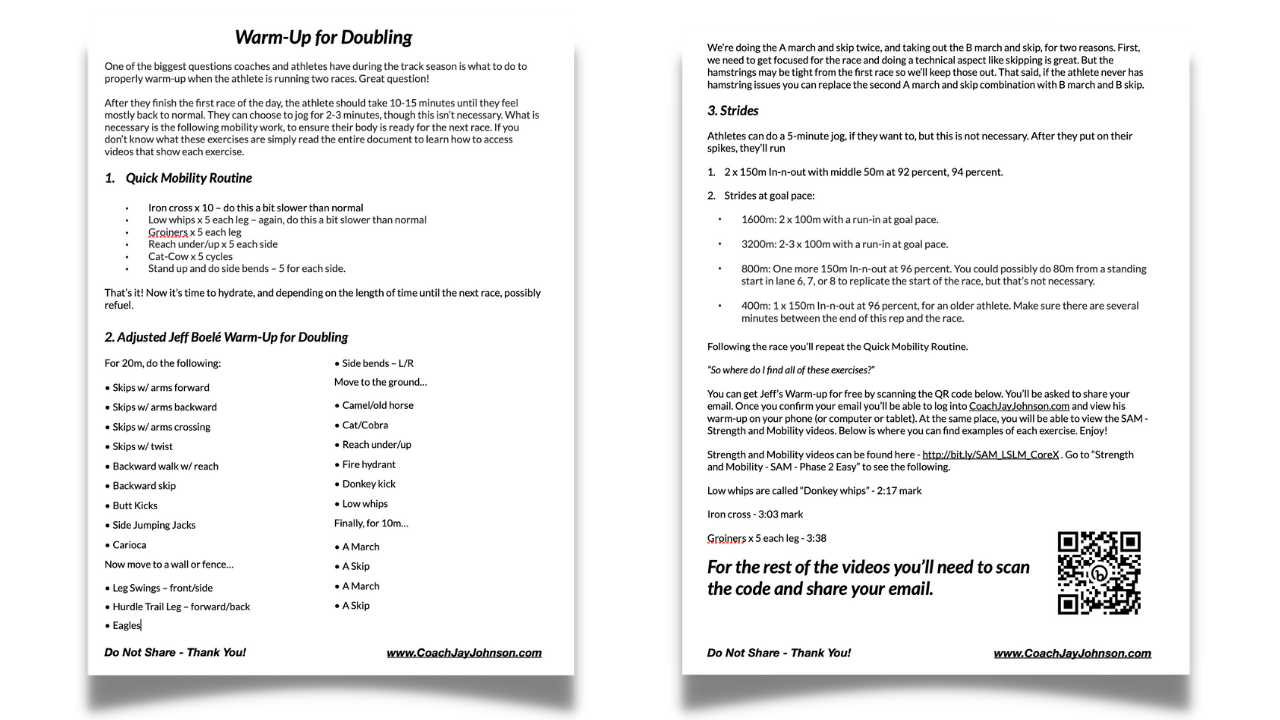
How to Warm-up Between Races
Continue reading...
📌 KEY TAKEAWAYS
- After the first race, take 10–15 minutes to feel mostly normal, then do a quick 6-exercise mobility routine (iron cross, low whips, groiners, reach under/up, cat-cow, side bends) before hydrating and refueling.
- Use an adjusted Jeff Boele warm-up for the second race: 20m of dynamic drills, wall/fence exercises (leg swings, hurdle trail leg, eagles), ground exercises, then A-march and A-skip sequences.
- Skip B-march and B-skip w...
Imagery for Runners
Continue reading...
📌 KEY TAKEAWAYS
- Mental imagery is a powerful tool for race preparation — find a quiet space and spend 3–10 minutes per day visualizing your race, starting 10–14 days out.
- In early sessions, envision everything going perfectly: the pace, the crowd, grabbing water easily, feeling strong. Build that positive mental picture first.
- Once the positive image is solid, practice visualizing things going wrong — a tough mile, a missed aid station — and...